🔥 Limited Spots: 40-Hour Proof of Concept for $2,500 | Tokyo 🇯🇵 & Delhi 🇮🇳 Offices | Claim Your Spot →



As global collaboration between Japan and India continues to grow, design has become more than aesthetics—it has become strategy.
From technology partnerships to cultural festivals and cross-border startups, the visual and digital language connecting these two nations is evolving. Businesses that understand these design shifts are building stronger brands, deeper trust, and wider impact.
Here are the key design trends shaping Japan–India collaboration in 2026—and why they matter.
1. Minimalism Meets Vibrancy
Japanese design is known for structure, clarity, and balance. Indian design is celebrated for color, energy, and storytelling.
The most successful collaborations in 2026 are not choosing one over the other—they are combining both.
What This Looks Like:
- Clean layouts with bold accent colors
- White space balanced with expressive gradients
- Structured typography paired with warm visual storytelling
- Cultural motifs used subtly, not excessively
This hybrid aesthetic feels:
- Professional enough for Japanese audiences
- Expressive enough for Indian identity
Brands that master this balance feel globally modern yet culturally grounded.
2. Bilingual UX as a Core Strategy
In 2026, bilingual design is no longer optional in cross-border collaboration—it is foundational.
Websites that operate between Japan and India must:
- Provide seamless language switching
- Maintain design consistency across languages
- Adapt typography for readability
- Structure content differently depending on cultural expectations
For example:
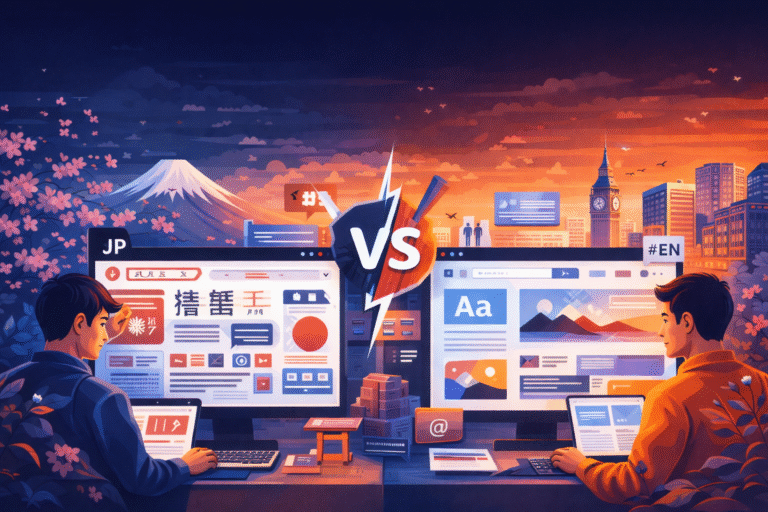
- Japanese pages may prefer more structured sections
- English pages may allow more narrative flow
The goal is not duplication. It is adaptation.
Designers must now think in parallel systems:
One identity, two user behaviors.
3. Cultural Authenticity Over Generic Globalism
In the past, many brands tried to look “international” by removing cultural identity. In 2026, the opposite is happening.
Audiences now appreciate:
- Cultural storytelling
- Heritage-inspired design
- Local symbolism
- Emotional authenticity
For Indo–Japan collaborations, this means:
- Using motifs like cherry blossoms and mandalas thoughtfully
- Incorporating festival themes without overwhelming minimal structure
- Highlighting shared values such as harmony, respect, and community
Authenticity builds trust faster than neutral design.
4. Experience-Driven Event Branding
Events are becoming immersive brand experiences rather than simple gatherings.
Design trends in cultural events now include:
- Cohesive stage branding systems
- Instagram-ready visual installations
- Branded signage integrated into the environment
- Digital extensions of physical events
Festivals celebrating Indo–Japan friendship are increasingly:
- Professionally branded
- Social media optimized
- Designed for long-term digital impact
The event does not end when people leave—it continues through photos, videos, and online storytelling.
5. Soft Gradients and Emotional Color Systems
Flat, single-color branding is slowly evolving into soft gradient systems.
Gradients represent:
- Movement
- Fusion
- Cultural blending
- Modernity
For Indo–Japan brands, gradient systems often blend:
- Warm saffron or red tones
- Cool navy or deep blue
- Soft pastel accents
The result feels dynamic yet refined—perfect for cross-cultural storytelling.
6. Typography That Speaks Two Worlds
Typography plays a crucial role in Japan–India collaboration.
In 2026, design teams are prioritizing:
- Clean geometric English fonts
- Japanese-friendly sans-serif pairings
- Careful spacing for bilingual harmony
- Strong headline hierarchy
Font pairing is now strategic.
Poor typography instantly signals inexperience in Japan.
Well-balanced bilingual typography communicates:
- Professionalism
- Respect
- Cultural awareness
7. Community-Centered Branding
Another major shift is the move from corporate-centered branding to community-centered branding.
Successful cross-border brands now:
- Showcase partnerships
- Highlight cultural engagement
- Feature community participation
- Emphasize shared values
This aligns strongly with both Japanese collectivism and Indian community culture.
Brand identity is becoming less about individual logos and more about shared experience.
8. Sustainable and Ethical Visual Messaging
Sustainability is increasingly influencing design choices.
In Japan, eco-conscious presentation matters.
In India, responsible growth is becoming central.
Design trends now include:
- Natural color palettes
- Earth-inspired visuals
- Clean, uncluttered layouts
- Transparent communication
Brands that visually express responsibility are gaining stronger long-term loyalty.
9. Digital-First Cultural Promotion
Cultural exchange used to depend primarily on physical presence. Today, digital platforms amplify everything.
Trends shaping 2026 include:
- Event teaser reels
- Bilingual Instagram storytelling
- Digital press kits
- Website-based cultural archives
Design now considers:
- Mobile-first viewing
- Social media shareability
- Fast loading performance
- Clear call-to-action structure
Digital storytelling is no longer secondary—it is central.
Why These Trends Matter for Businesses
Understanding these trends is not just about looking modern.
It is about:
- Building trust in two markets
- Avoiding cultural missteps
- Increasing digital engagement
- Creating memorable brand experiences
Businesses that ignore cultural nuance risk appearing generic or disconnected.
Those that adapt intelligently stand out.
The Future of Japan–India Creative Collaboration
As collaboration between Japan and India expands in technology, culture, and business, design will continue to act as a bridge.
Future-forward brands will:
- Think beyond borders
- Respect cultural identity
- Use design strategically
- Balance precision with creativity
Cross-cultural innovation is not accidental—it is intentional.
Final Thoughts
Design is no longer just visual decoration. It is a language.
And in Japan–India collaboration, that language must speak clearly, respectfully, and creatively.
Brands that combine structure with imagination—minimalism with vibrancy—will lead the next generation of cross-cultural innovation.