🔥 Limited Spots: 40-Hour Proof of Concept for $2,500 | Tokyo 🇯🇵 & Delhi 🇮🇳 Offices | Claim Your Spot →



Japan is one of the most attractive yet challenging markets in the world. With a stable economy, high purchasing power, and strong brand loyalty, it offers tremendous opportunity. However, many Indian businesses struggle when entering Japan—not because their products are weak, but because their approach lacks cultural alignment.
Success in Japan requires more than translation. It requires localization, trust-building, and strategic positioning.
At Japian, we have observed that businesses that understand Japan’s cultural expectations perform significantly better than those that simply replicate their home-market strategy.
Here’s how Indian businesses can succeed in the Japanese market.
1. Understand That Trust Comes Before Sales
In Japan, business relationships are built slowly and carefully. Unlike some fast-moving markets, Japanese consumers and companies prioritize:
- Reliability
- Reputation
- Consistency
- Professional presentation
Trust is not earned through aggressive marketing. It is earned through clear communication, polished branding, and long-term commitment.
Practical Advice:
- Invest in professional branding before market entry
- Ensure your website looks structured and credible
- Provide clear company information and contact details
- Highlight certifications, partnerships, and track records
A well-designed website often determines whether a Japanese customer takes you seriously.
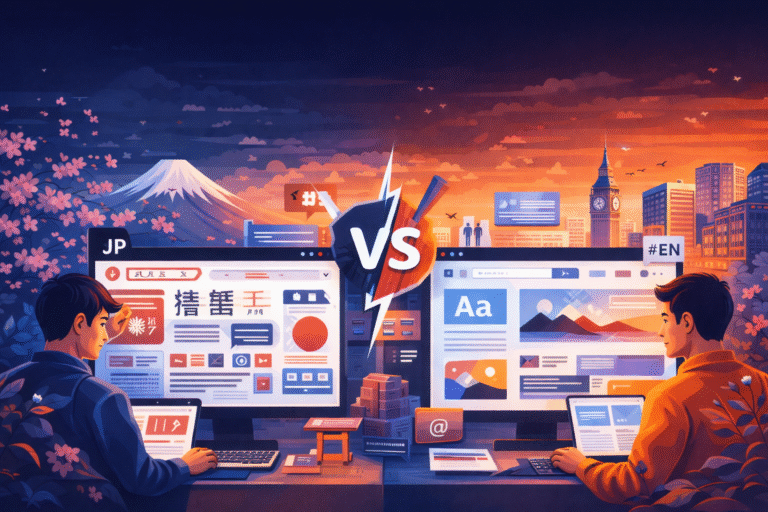
2. Localization Is More Than Translation
Many businesses assume that translating English content into Japanese is enough. It is not.
Japanese audiences expect:
- Natural, culturally appropriate language
- Structured layouts
- Calm and organized visual hierarchy
- Respectful tone
Even small design differences matter. For example:
- Dense layouts that work in India may feel overwhelming in Japan
- Bright, bold messaging may need balancing with subtle design
- Navigation must feel intuitive and structured
Localization involves:
- Language
- Visual design
- User experience
- Cultural tone
At Japian, localization is always treated as a design strategy—not just a language task.
3. Adapt Your Branding to Japanese Sensibilities
Japanese branding emphasizes clarity, subtlety, and harmony.
Indian brands entering Japan should consider:
- Simplifying visual clutter
- Using balanced color palettes
- Avoiding overly aggressive marketing slogans
- Emphasizing reliability and long-term value
This does not mean removing Indian identity. Instead, it means presenting it in a way that feels refined and structured.
The most successful cross-cultural brands combine:
- Indian warmth and creativity
- Japanese minimalism and precision
That fusion builds both familiarity and trust.
4. Invest in Bilingual Digital Presence
If you want to operate in Japan, your digital presence must speak Japanese—fluently.
A strong bilingual website should:
- Offer complete Japanese navigation
- Avoid machine translation
- Maintain consistent branding across languages
- Ensure mobile optimization
Remember, Japan is a mobile-first society. A slow or poorly structured mobile site can damage credibility instantly.
SEO is also critical. Target keywords should include both:
- English terms
- Japanese search terms
For example:
- “Indian restaurant Osaka”
- 「インド料理 大阪」
Search behavior differs across languages, and your strategy must reflect that.
5. Participate in Community and Cultural Engagement
Japan values community and relationships. One of the most powerful ways to build brand presence is through:
- Cultural festivals
- Business networking events
- Local partnerships
- Industry exhibitions
Events allow businesses to:
- Build face-to-face trust
- Demonstrate authenticity
- Engage directly with customers
Participation in cultural initiatives, such as India–Japan festivals or wellness events, can significantly strengthen brand visibility.
At Japian, we have seen how event presence combined with strong branding multiplies long-term brand recognition.
6. Respect Business Etiquette and Communication Norms
Japanese business culture emphasizes:
- Formal communication
- Punctuality
- Structured meetings
- Detailed documentation
Quick decisions are less common than in India. Follow-ups and written confirmations are often expected.
Indian businesses should:
- Prepare structured proposals
- Provide clear documentation
- Maintain professional email communication
- Show patience in negotiations
Respecting these norms builds credibility.
7. Think Long-Term, Not Short-Term
Japan rewards consistency. Brands that demonstrate long-term commitment gain loyalty.
Avoid:
- Short-term promotional tactics
- Aggressive discount campaigns
- Inconsistent branding
Instead, focus on:
- Stable brand messaging
- Reliable service
- High-quality customer support
Patience is often the difference between success and failure in Japan.
8. Build Strategic Local Partnerships
Entering Japan alone can be difficult. Collaborating with local partners can accelerate growth.
Consider:
- Local design agencies
- Cultural event organizers
- Business consultants
- Distribution partners
A local partner helps you:
- Navigate regulations
- Adapt marketing strategies
- Build credibility
Cross-border collaboration works best when both sides respect each other’s strengths.
9. Use Design as a Competitive Advantage
Design is not decoration—it is positioning.
In Japan, consumers evaluate:
- Packaging quality
- Website structure
- Visual clarity
- Consistency across materials
Professional design communicates:
- Stability
- Attention to detail
- Respect for customers
Businesses that underestimate design often struggle to compete.
The Opportunity Is Real
Japan and India share strong diplomatic and economic relations. The interest in Indian food, culture, technology, and wellness continues to grow in Japan.
However, success requires:
- Cultural understanding
- Strategic localization
- Professional branding
- Long-term mindset
Indian businesses that invest in thoughtful entry strategies can build strong, lasting success in the Japanese market.
Final Thoughts
Entering Japan is not about copying your existing strategy. It is about adapting intelligently.
The businesses that succeed are those that:
- Respect cultural nuance
- Build trust gradually
- Communicate clearly
- Invest in strong design and branding
With the right approach, Japan is not a difficult market—it is a rewarding one.
About Japian
Japian is a Japan–India creative brand specializing in web design, branding, event management, and cross-cultural collaboration. Japian helps businesses localize, adapt, and succeed in new markets through thoughtful design and strategic creativity.