🔥 Limited Spots: 40-Hour Proof of Concept for $2,500 | Tokyo 🇯🇵 & Delhi 🇮🇳 Offices | Claim Your Spot →


Everything You Need to Know About Creating Successful Japanese Websites
Creating a successful website in Japan requires more than just good design—it demands a deep understanding of Japanese culture, user preferences, business practices, and the unique digital landscape. Whether you’re a business owner, entrepreneur, or marketing professional, this comprehensive guide will walk you through everything you need to know about website design in Japan for 2026 and beyond.
From cultural nuances and design aesthetics to technical requirements and SEO strategies, we’ll cover the complete spectrum of what makes Japanese websites successful. This guide is based on over seven years of experience creating websites for Japanese businesses and international companies entering the Japanese market.
1. Understanding the Japanese Digital Landscape
1.1 The Japanese Internet Market in 2026
Japan’s internet penetration rate exceeds 95%, with over 120 million active internet users. The Japanese digital market is one of the most sophisticated and mature in the world, with unique characteristics that set it apart from Western markets.
Key Statistics:
- Mobile internet usage: 78% of Japanese users primarily access the internet via smartphones
- E-commerce growth: Online shopping market valued at ¥22.7 trillion in 2025
- Average session duration: 15-20 minutes on desktop, 8-12 minutes on mobile
- Preferred browsers: Chrome (52%), Safari (33%), Edge (8%)
- Social media penetration: LINE (92%), Twitter/X (58%), Instagram (48%)
1.2 Why Japanese Websites Look Different
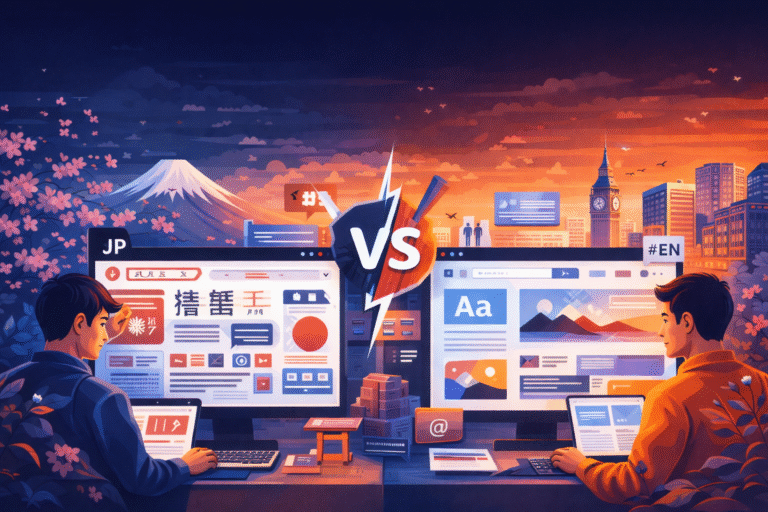
If you’ve browsed Japanese websites, you’ve likely noticed they look distinctly different from Western sites. This isn’t accidental—it’s the result of cultural preferences, information density expectations, and established user behavior patterns.
Key Differences:
- Information Density: Japanese users prefer detailed information upfront rather than minimalist designs. What Westerners might consider ‘cluttered,’ Japanese users find comprehensive and trustworthy.
- Visual Hierarchy: Japanese websites typically feature multiple visual elements competing for attention, reflecting the busy urban environments and print media traditions.
- Trust Signals: Extensive use of certifications, awards, media mentions, and detailed company information to build trust.
- Text-Heavy Content: Japanese characters convey more information per character than English, allowing for information-dense layouts that remain readable.
- Politeness and Formality: Language and tone are carefully calibrated to show respect and maintain business etiquette.
2. Cultural Considerations in Japanese Web Design
2.1 The Importance of Trust and Credibility
Trust is paramount in Japanese business culture. Your website must establish credibility from the first moment a visitor arrives. Japanese consumers are typically more cautious about online transactions and require substantial evidence of legitimacy before making purchases or commitments.
Essential Trust Elements:
- Company Information: Include detailed 会社概要 (kaisha gaiyo – company overview) with founding date, capital, number of employees, and physical address.
- Representative Details: Show the name and photo of the company president or representative director (代表取締役).
- Business Registration: Display your business registration number (法人番号) and relevant licenses.
- Customer Support: Provide multiple contact methods including phone numbers with business hours clearly stated.
- Security Certificates: Display SSL certificates and security badges prominently.
- Media Appearances: Showcase any TV appearances, newspaper articles, or magazine features.
2.2 Color Psychology in Japanese Design
Colors carry specific cultural meanings in Japan that differ from Western interpretations. Understanding these associations is crucial for effective communication through design.
Red (赤 – aka):
Red symbolizes celebration, vitality, and good fortune in Japan. It’s commonly used for sale prices, promotional banners, and call-to-action buttons. However, red text was traditionally used for writing names of the deceased, so be cautious about using red for people’s names. Red is an excellent choice for e-commerce sale banners and urgent notifications.
Blue (青 – ao):
Blue represents trust, cleanliness, and reliability. It’s the most popular color for corporate websites in Japan, particularly in finance, healthcare, and technology sectors. Light blue is associated with youth and freshness, while navy blue conveys stability and professionalism.
White (白 – shiro):
White symbolizes purity, cleanliness, and simplicity. It’s essential for creating breathing space in information-dense layouts. White space is valued for its ability to provide visual rest and highlight important content. Japanese websites typically use more white space than might initially appear, strategically placed to guide the eye.
Yellow (黄色 – kiiro):
Yellow represents cheerfulness and attention. It’s commonly used for highlighting special offers or important information. Be cautious with yellow backgrounds as they can strain the eyes if overused. Yellow works best as an accent color for callouts and notifications.
Green (緑 – midori):
Green symbolizes nature, health, and safety. It’s popular for healthcare, environmental, and organic food websites. The color is associated with newness and freshness, making it suitable for promoting natural or eco-friendly products.
Black (黒 – kuro):
Black represents formality, elegance, and luxury. It’s used for premium brands and high-end products. However, black can also symbolize death and mourning, so use it thoughtfully depending on your industry and target audience. Black text on white backgrounds remains the standard for readability.
2.3 Typography and Japanese Text
Japanese text presents unique typography challenges due to the combination of three writing systems: hiragana, katakana, and kanji. Additionally, websites often include English text for international appeal or technical terms.
Font Selection Guidelines:
- System Fonts: Use web-safe Japanese fonts like Hiragino, Yu Gothic, Meiryo, or MS PGothic as fallbacks.
- Gothic vs. Mincho: Gothic (sans-serif) fonts are standard for body text on screens, while Mincho (serif) fonts are used for formal documents and print materials.
- Font Size: Japanese text requires larger font sizes than English for equivalent readability. Minimum 14px for body text, 16px preferred.
- Line Height: Set line-height to 1.7-2.0 for Japanese text (compared to 1.5 for English) to accommodate vertical character spacing.
- Character Spacing: Avoid letter-spacing for Japanese text; it disrupts readability unlike English text.
Text Direction Considerations:
While modern Japanese websites predominantly use horizontal text (横書き – yokogaki), vertical text (縦書き – tategaki) is still used for specific purposes such as traditional businesses, literary content, or to create a specific aesthetic. Most websites should stick with horizontal text for better compatibility with modern web standards and mobile devices.
3. Essential Website Features for the Japanese Market
3.1 Navigation Structure
Japanese websites typically feature more complex navigation systems than their Western counterparts, reflecting the preference for comprehensive information access. Users expect to see all available options rather than having content hidden behind minimalist navigation.
Standard Navigation Elements:
- Mega Menus: Use dropdown menus that show multiple levels of navigation simultaneously, allowing users to see the site structure at a glance.
- Sidebar Navigation: Include a persistent sidebar with quick links to important pages and categories.
- Footer Site Map: Provide a comprehensive footer with links to all major pages, organized by category.
- Breadcrumbs: Always include breadcrumb navigation to show users their location within the site hierarchy.
- Search Function: Prominent search bar with auto-complete suggestions in both Japanese and English where applicable.
3.2 Contact and Communication
Japanese users value multiple contact methods and expect detailed information about how to reach your business. Communication features should be prominent and comprehensive.
Essential Contact Features:
- Phone Numbers: Display phone numbers prominently with business hours. Include separate numbers for sales, support, and general inquiries if applicable.
- Contact Forms: Provide detailed forms with multiple fields. Japanese users expect structured forms rather than simple message boxes.
- LINE Integration: Offer LINE as a contact method. With 92% penetration, LINE is the preferred messaging platform in Japan.
- Physical Address: Display your complete physical address with a map. Include the nearest train station and walking time.
- Email Response Time: Clearly state expected response times for email inquiries (typically within 24 hours for weekdays).
- FAQ Section: Comprehensive よくある質問 (Frequently Asked Questions) section to address common concerns before contact.
3.3 E-commerce Functionality
If your website includes e-commerce functionality, Japanese consumers have specific expectations that differ significantly from Western markets.
Required E-commerce Features:
- Payment Options: Integrate popular Japanese payment methods including credit cards, bank transfers, convenience store payment (コンビニ払い), PayPay, Rakuten Pay, and cash on delivery (代金引換).
- Guest Checkout: While account creation builds loyalty, always offer guest checkout options for convenience.
- Detailed Product Information: Include comprehensive specifications, multiple product images, size charts with Japanese measurements, and customer reviews.
- Shipping Information: Clearly display shipping costs, delivery timeframes, and available delivery time slots (時間指定配達).
- Return Policy: Explicit return policy (返品・交換について) with clear conditions and timeframes.
- Gift Wrapping: Offer gift wrapping (ギフトラッピング) and message card options, especially important during gift-giving seasons.
3.4 Mobile Optimization
With 78% of Japanese internet users primarily accessing websites via smartphones, mobile optimization isn’t optional—it’s essential. However, Japanese mobile users have specific expectations that go beyond standard responsive design.
Mobile Design Priorities:
- Fast Loading: Optimize for loading speeds under 3 seconds on 4G connections. Japanese users are accustomed to fast mobile internet and won’t wait.
- Thumb-Friendly Design: Ensure all interactive elements are at least 44×44 pixels and positioned for easy thumb access.
- Click-to-Call: Make phone numbers automatically callable with a single tap. Include tap-to-LINE buttons where applicable.
- Simplified Forms: Reduce form fields on mobile while maintaining data quality. Use autofill and dropdown menus extensively.
- Fixed Navigation: Implement sticky headers with key navigation options always accessible.
- Progressive Web App: Consider PWA features like offline access and home screen installation for better engagement.
4. Technical Requirements and SEO
4.1 Domain and Hosting Considerations
Your domain name and hosting choices significantly impact your website’s performance and credibility in Japan.
Domain Options:
- .jp Domain: Most trusted domain for Japanese businesses. Requires registration with a Japanese address but provides maximum local credibility.
- .co.jp Domain: Reserved for registered Japanese corporations. Highest trust level but requires corporate registration in Japan.
- .com Domain: Acceptable for international businesses but consider .jp for local credibility.
- Japanese Characters: You can register domains with Japanese characters (日本語.jp) but they’re less common and harder to type.
Hosting Recommendations:
- Local Servers: Host on servers located in Japan for optimal loading speeds. Popular providers include Sakura Internet, Xserver, and ConoHa.
- CDN: Use a Content Delivery Network with Japanese edge servers to further optimize performance.
- Uptime Guarantee: Choose hosting with 99.9%+ uptime guarantees and 24/7 support in Japanese.
- SSL Certificate: Mandatory for all websites. Japanese users are particularly security-conscious.
4.2 Japanese SEO Strategy
Search Engine Optimization in Japan follows similar principles to global SEO but with important local nuances. Google dominates with over 77% market share, followed by Yahoo! Japan (which uses Google’s search algorithm) and Bing.
Keyword Research:
- Japanese Search Patterns: Japanese users often search using different combinations of hiragana, katakana, and kanji for the same concept.
- Long-tail Keywords: Japanese allows for very specific, long-tail searches due to character efficiency. Target these for better conversion rates.
- Local Intent: Include location-specific keywords like 大阪 (Osaka), 東京 (Tokyo), or neighborhood names for local SEO.
- Tool Selection: Use Google Keyword Planner with Japanese language settings, and consider tools like Ubersuggest or Ahrefs for Japanese keyword data.
On-Page SEO:
- Title Tags: Keep titles under 30 characters for mobile display. Include primary keyword and company name.
- Meta Descriptions: Write compelling descriptions in Japanese, 80-120 characters. Include call-to-action phrases.
- Header Tags: Structure content with proper H1-H6 tags. Japanese SEO particularly values well-structured content.
- Alt Text: Provide Japanese alt text for all images. This improves accessibility and image search rankings.
- Internal Linking: Create a robust internal linking structure. Japanese websites benefit from extensive cross-linking.
- Schema Markup: Implement structured data for local business, products, reviews, and events.
Technical SEO:
- Page Speed: Aim for loading times under 2 seconds on mobile. Use Google PageSpeed Insights for Japanese users.
- Mobile-First Indexing: Ensure mobile version is complete and fully functional. Google prioritizes mobile content.
- XML Sitemap: Submit a comprehensive sitemap to Google Search Console and Yahoo! Japan.
- Robots.txt: Configure properly to allow crawling of all important content while blocking admin pages.
- Core Web Vitals: Optimize for LCP (Largest Contentful Paint), FID (First Input Delay), and CLS (Cumulative Layout Shift).
4.3 Local SEO for Japanese Businesses
Local SEO is crucial for businesses serving specific geographic areas in Japan. Google My Business (Google ビジネスプロフィール) optimization is essential.
Google My Business Optimization:
- Complete Profile: Fill out every section including business hours, services, attributes, and product catalog.
- Japanese Description: Write a detailed business description in natural Japanese with relevant keywords.
- Photos: Upload high-quality photos regularly. Include exterior, interior, products, and team photos.
- Reviews: Actively encourage customer reviews. Respond to all reviews in polite Japanese within 24-48 hours.
- Posts: Regularly publish Google Posts about news, offers, and events in Japanese.
- Q&A: Monitor and answer questions promptly. Add frequently asked questions proactively.
Japanese Directory Listings:
Submit your business to popular Japanese directories including エキテン (Ekiten), iタウンページ (i-Townpage), Yahoo! ロコ (Yahoo! Loco), ホットペッパー (Hot Pepper), and industry-specific directories relevant to your business category.
5. Website Content Strategy
5.1 Writing for Japanese Audiences
Content is the foundation of any successful website, and Japanese content requires special attention to language level, tone, and cultural appropriateness.
Language Formality Levels:
- Keigo (敬語): Polite language is essential for business websites. Use です/ます (desu/masu) forms consistently.
- Humble Forms: Use humble language when referring to your company’s actions (いたす, 申し上げる).
- Honorific Forms: Use respectful language when referring to customers (お客様, ご利用いただく).
- Consistency: Maintain the same formality level throughout your website. Mixing levels appears unprofessional.
Content Organization:
- Front-Loading: Put important information first. Japanese users scan from top to bottom, left to right.
- Bullet Points: Use bullet points for easy scanning, but ensure they’re part of complete, grammatical sentences.
- Paragraphs: Keep paragraphs shorter than in English. 2-4 sentences per paragraph is ideal for web content.
- Headings: Use clear, descriptive headings that help users quickly understand content sections.
- Visual Breaks: Include images, icons, or colored boxes to break up text and maintain visual interest.
Conclusion
Creating a successful website for the Japanese market requires careful attention to cultural preferences, user expectations, and technical requirements. By understanding these unique aspects and implementing the strategies outlined in this guide, you can create a website that not only looks professional but also resonates with Japanese users and drives business results.
Key takeaways include the importance of building trust through comprehensive information, respecting cultural color associations, providing multiple contact methods, optimizing for mobile-first users, and implementing thorough Japanese SEO strategies. Remember that Japanese web design isn’t about following Western trends—it’s about meeting the specific needs and preferences of Japanese users.
Whether you’re a Japanese business owner looking to improve your online presence or an international company entering the Japanese market, investing in proper website design and localization will pay dividends in user engagement, trust, and conversions.
At Japian, we specialize in creating websites that bridge cultures and drive results. With over seven years of experience serving clients across Japan and internationally, we understand the nuances of Japanese web design and are ready to help bring your vision to life. Contact us today to discuss your project.