🔥 Limited Spots: 40-Hour Proof of Concept for $2,500 | Tokyo 🇯🇵 & Delhi 🇮🇳 Offices | Claim Your Spot →



Japan’s digital landscape is evolving rapidly. As international collaboration increases and global audiences engage with Japanese businesses more than ever, bilingual digital presence has moved from optional to essential.
In 2026, businesses operating in Japan can no longer rely on single-language websites. Whether targeting tourists, global investors, international students, or cross-border partnerships, bilingual design is now a strategic necessity.
At Japian, we see bilingual design not as translation—but as intelligent cross-cultural experience design.
Why Bilingual Design Is No Longer Optional
Japan has traditionally operated as a primarily Japanese-language market. However, several shifts have changed this:
- Increase in international tourism
- Growing foreign resident population
- Rise in global business partnerships
- Expansion of Japanese brands overseas
- Stronger India–Japan collaboration
Today’s customers expect accessibility. If they cannot navigate your website comfortably, they leave.
A bilingual website:
- Increases trust
- Expands reach
- Improves brand credibility
- Strengthens global positioning
It signals that your brand understands diversity.
Translation vs. Localization
Many businesses believe bilingual design means adding Google Translate or duplicating pages. That approach fails.
True bilingual design requires:
- Cultural adaptation
- UX restructuring
- Typography adjustments
- Content tone refinement
- Visual rebalancing
For example:
- Japanese users often prefer structured, detailed information.
- English-speaking users may prefer concise and story-driven content.
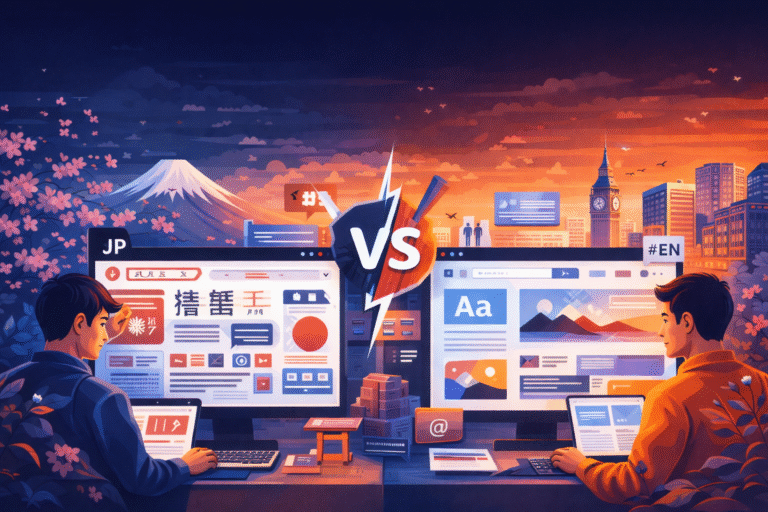
The layout that works in one language may not feel natural in another.
At Japian, bilingual design means creating parallel experiences under one unified identity.
Typography: The Hidden Challenge
One of the biggest challenges in bilingual design is typography.
Japanese text:
- Uses more characters per word
- Requires different spacing
- Demands careful font pairing
If fonts are mismatched, the website immediately feels unprofessional.
Effective bilingual typography:
- Uses clean geometric fonts for English
- Pairs them with readable Japanese sans-serif fonts
- Maintains consistent hierarchy
- Ensures visual harmony between scripts
Typography communicates professionalism instantly—especially in Japan.
User Experience Differences Between Markets
Japanese digital behavior differs from Western UX patterns.
In Japan:
- Information density can be higher
- Trust elements are important (company info, contact details, certifications)
- Structured navigation is expected
- Visual calm is appreciated
In global markets:
- Minimal storytelling layouts may work
- Strong call-to-action placement is key
- Visual boldness is more accepted
A bilingual website must balance both behaviors without feeling inconsistent.
This is where strategic design matters most.
SEO Strategy for Bilingual Websites
Search behavior differs across languages.
For example:
- “Indian restaurant Osaka”
- 「インド料理 大阪」
Both phrases may target the same audience but appear in different search patterns.
A strong bilingual SEO strategy includes:
- Separate keyword research for each language
- Structured URL hierarchy (/en, /jp)
- Optimized meta descriptions in both languages
- Proper hreflang tagging
- Fast mobile performance
Without SEO localization, even the best-designed site remains invisible.
Brand Consistency Across Languages
One common mistake businesses make is treating bilingual pages as separate identities.
Brand identity must remain consistent across languages:
- Same color system
- Same visual tone
- Same logo placement
- Same structural clarity
The language changes—but the personality should not.
Consistency builds recognition and trust.
Mobile-First Is Critical in Japan
Japan has one of the most mobile-driven digital audiences in the world.
Bilingual websites must:
- Load quickly
- Display Japanese characters properly
- Maintain spacing and readability on small screens
- Keep navigation simple and clear
If a bilingual site works only on desktop, it fails strategically.
Bilingual Design as Competitive Advantage
Many businesses still hesitate to invest in professional bilingual design. That hesitation creates opportunity.
Brands that implement strong bilingual digital systems:
- Stand out instantly
- Appear more global
- Attract partnerships
- Increase conversion rates
In cross-cultural markets like Japan–India collaboration, bilingual presence is not just helpful—it is positioning.
The Future of Japan’s Digital Landscape
As globalization deepens, we will see:
- More international businesses entering Japan
- More Japanese companies expanding globally
- Stronger cross-border collaboration
- Higher expectation of digital accessibility
The brands that prepare now will lead tomorrow.
Bilingual design will move from advantage to standard.
Final Thoughts
A bilingual website is not about speaking two languages.
It is about respecting two audiences.
It reflects:
- Cultural awareness
- Professional maturity
- Global ambition
In Japan’s evolving digital ecosystem, bilingual design is becoming one of the strongest indicators of a forward-thinking brand.
Businesses that adapt early will benefit the most.